
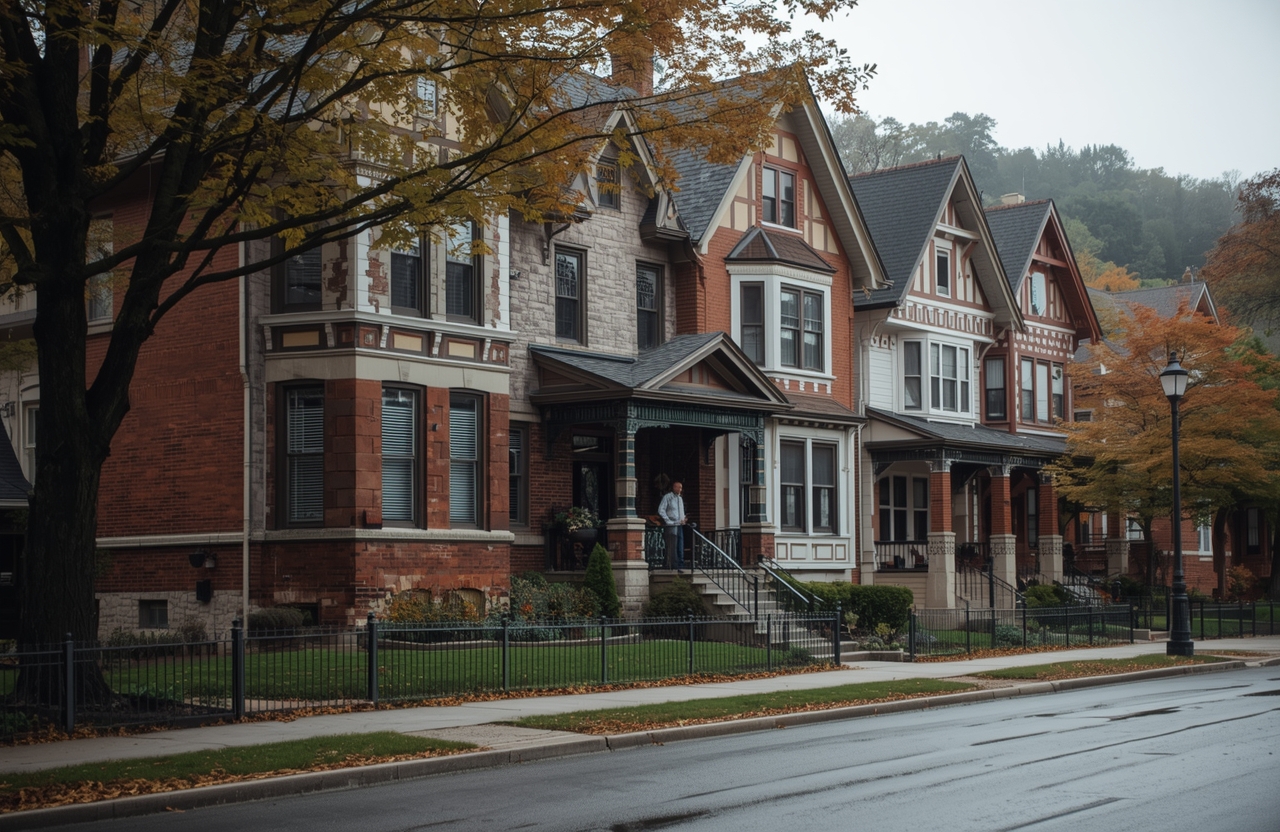
A mold problem in Mt. Lebanon usually has more to do with the age of the house than with the neighborhood. The municipality developed mostly in the 1920s and 1930s as a streetcar suburb of Pittsburgh, and the streets around Washington Road and Beverly Road are lined with two-story brick, stone and stucco houses built close together on steep lots. Each one has been through a long list of owners, repairs and renovations. That history is what a mold specialist reads.
This page covers what is typical of houses here, where moisture and mold tend to turn up, and what to check before you hire anyone. The notes are general, since every house differs.
What the houses are like
Many Mt. Lebanon homes are Tudor, Colonial Revival and similar styles from the interwar years, with masonry exteriors, steep roofs and attics tucked under dormers. Inside you often find plaster over wood lath, hardwood floors on joists and a basement of stone, brick or early block. Slate and tile roofs are not unusual, and some older houses have built-in or box gutters tucked into the roof edge rather than hanging gutters. Those are long-lasting when maintained and a common source of slow roof leaks when they are not.
Basements were built as cellars: a furnace, a coal room that later became storage, a laundry and a floor drain. Starting in the 1950s and 1960s, many owners finished part of the space with wood paneling, a drop ceiling and carpet, a pattern that still shows up in houses today.
Where mold tends to show up
Finished basement walls. Paneling and drywall set against an old masonry wall, with no air gap, can hold damp behind them for years. A musty smell in a finished basement with nothing visible is a reason to check the wall cavity with a moisture meter. The page on basement mold removal covers the causes and the fixes.
The masonry itself. Old stone and brick wicks groundwater, especially on the uphill side of a hillside lot. White mineral crust on the wall shows water moving through. Mold then grows on whatever is stored or built against it.
Attics under steep roofs. Many attics have limited ventilation, bath fans that were never run to the outdoors, and insulation added over the years in uneven layers. Dark staining on the north slope of the roof boards is the usual condensation pattern, described on the attic mold removal page.
Box gutters and flashing. A small failure in a built-in gutter, a chimney flashing or a dormer valley lets water in slowly. The first sign may be a ceiling stain on the second floor or damp plaster along an exterior wall.
Sewer laterals and trees. Mature trees line many streets. Roots can invade older clay or cast-iron sewer lines, and a partial blockage that backs up into a basement drain is a contamination problem, not a clean-water one.
Plaster, lath and what comes out
Removing mold from a plaster wall is not like removing drywall. Plaster is heavy, dusty and often painted in layers that may contain lead in a pre-1978 house. The specialist sets up containment, protects the floors and the stairway and works in a way that holds dust down. Wood lath behind plaster can carry mold after water damage and is removed with the plaster if it is affected. In a house this age, ask the company about lead-safe work practices and whether suspect pipe wrap or floor tile has been checked for asbestos before demolition. In Allegheny County, the Allegheny County Health Department enforces air quality rules for asbestos in renovation and demolition.
Buying or selling here
Many Allegheny County municipalities require an inspection or certificate when a house changes hands, and the rules, the fees and the repair deadlines differ from one municipality to the next. Check with the Mt. Lebanon code office about its requirements, and ask your agent how an inspection finding that involves moisture or mold would be handled in your agreement of sale. The guide on mold when you buy or sell a house lays out the timing and the questions to ask.
Questions people ask here
Is a musty basement normal in an older Mt. Lebanon house?
It is common, and it is a sign of dampness, not a fact of life. A dehumidifier, gutter and grading fixes and removing materials stored against exterior walls often change it a lot. If the smell is strong or you see staining, an inspection is worth the cost.
The ceiling stain on my second floor came back after painting. Why?
The source was probably never fixed. A chimney, a dormer valley, a box gutter or a bath fan duct can feed a stain for years. Paint covers it, and the next wet spell shows it again.
Do I need a permit to remove mold?
Mold removal itself generally does not need a permit in Pennsylvania, but demolition and rebuilding can, depending on the work. Ask the municipal code office and the company what applies to your job.
Nearby
The same housing story runs through the older parts of Bethel Park and Upper St. Clair, though postwar construction there looks different. If you are not sure what you are dealing with, start with mold inspection and testing, and see mold removal for what a proper job involves.