
This site is about mold, and water damage is on it for one reason: almost all mold starts with water that stayed too long. A burst pipe, a failed water heater, a roof leak, a basement that took in storm water or an appliance hose that let go will each leave materials wet, and wet materials grow mold within a few days if they are not dried. This page covers what to do in the first hours, how professional drying works, what can be saved and what cannot, and how to tell when a water problem has become a mold problem.
It is a supporting page. Water damage from a flood, a sewer backup or a large leak is a restoration job, and the independent company that handles calls from this site can talk through what yours needs. For the mold side, see mold removal and basement mold removal.
The first hour: stop the water and stay safe
- Stop the source if you can. Shut off the main water valve for a burst pipe or supply line, the water heater supply, or the appliance valve. Know where your main shutoff is before you ever need it.
- Think about electricity. Water and power do not mix. If water is touching outlets, appliances, a panel or a cord, or standing near them, do not walk into it. Turn off power at the breaker only if you can reach the panel safely and dry. If you cannot, call your utility or an electrician.
- Know what kind of water it is. Clean water from a supply line or a roof leak is the best case. Water from a washing machine, dishwasher or toilet tank is gray or mildly dirty. Sewage, river or floodwater and water that has been standing for days is contaminated and is a different job. Treat contaminated water as hazardous and keep children and pets away.
- Photograph everything. Take photos and video of the damage before you move anything. They matter for any insurance claim.
- Remove what you can safely lift. Small items, rugs, furniture legs from wet carpet, papers and electronics can go to a dry room. Do not lift heavy wet carpet or ceiling material that could fall.
- Start air and drying where safe. Open windows if the weather allows, run fans and a dehumidifier if the power is safe, and mop up standing water. This helps but does not replace professional drying for anything beyond a small spill.
The clock: why the first 24 to 48 hours matter
Mold spores are already in every house. They need moisture, a food source such as paper, wood or dust, and time. On wet drywall, carpet, cardboard and wood, growth can begin within a day or two, and visible mold often appears within three to five days. The EPA's guidance for flooded homes is to dry or remove wet materials within 24 to 48 hours. That is not a deadline after which everything is ruined, but the risk climbs quickly, so speed is the point.
How professional drying works
Drying a structure is a measured process, not a few fans.
Extraction. Standing water is pumped or vacuumed out first. Removing liquid water is far faster than evaporating it.
Moisture mapping. The crew uses meters to find how far the water traveled. Water moves along floors, up walls by wicking and into the cavities behind baseboards, so wet material often extends beyond what you can see.
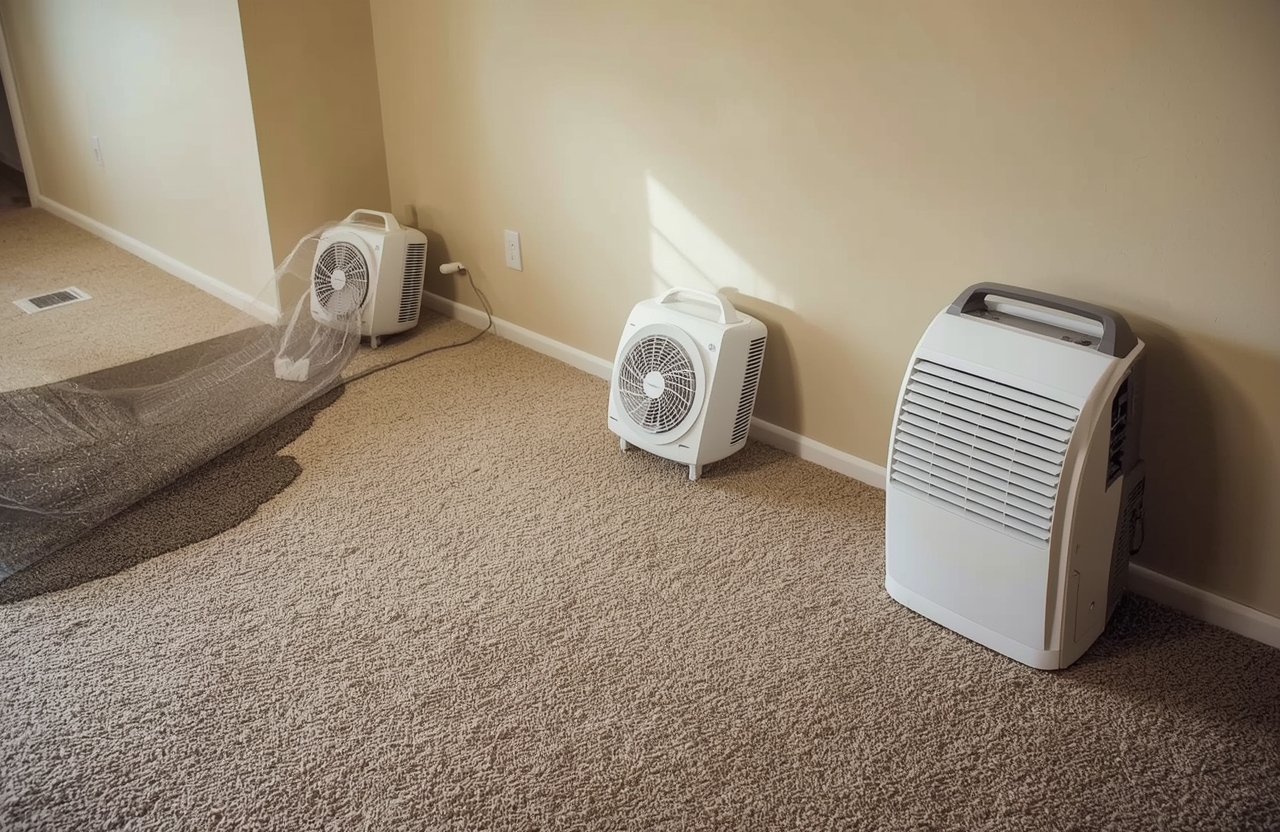
Air movement and dehumidification. Air movers, which are low, high-speed fans, push air across wet surfaces. Dehumidifiers pull the moisture out of the air so the drying does not simply raise humidity in the house. Both run continuously, usually with doors and windows closed so the dehumidifiers work against a fixed volume of air. The equipment is loud and uses a lot of electricity for a few days.
Opening cavities. Sometimes small holes are cut or baseboards removed to let wall cavities dry, or wet insulation is pulled out.
Daily readings. A crew should come back, check moisture readings and adjust the equipment. Drying is finished when the readings return to a normal dry range for that material, not when the surface feels dry.
A typical clean-water job dries in three to five days, and larger or hidden-water jobs take longer. The industry standard for this work is ANSI/IICRC S500. Ask any company which standard it follows and how it documents readings.
What can be saved and what cannot
Most hard materials survive clean water. Wood, concrete, tile and metal dry out. Soft and porous materials are the problem, and the answer depends on how long they were wet and how dirty the water was.
- Drywall. Often salvageable after a quick clean-water leak if dried promptly, and replaced if it stayed wet, is stained or has grown mold. Sewage contact means replacement.
- Insulation. Fiberglass in a wet wall cavity is usually removed and replaced, especially if the wall stayed closed.
- Carpet and pad. Clean-water carpet can often be dried in place if it is extracted quickly. The pad is more often replaced. Contaminated water means both go.
- Hardwood and laminate. Solid hardwood sometimes dries, but cupping and buckling may show up later. Laminate and engineered flooring often swell and are replaced.
- Furniture and contents. Solid wood and hard goods can be dried and cleaned. Upholstery and particleboard furniture that soaked are usually lost.
- Cardboard and paper. Discard soaked boxes, papers and books unless they are valuable enough to specialist-freeze and restore.
Common water losses in the Pittsburgh area
Frozen and burst pipes. Western Pennsylvania has hard cold snaps, and pipes in exterior walls, unheated basements, crawl spaces and attics freeze and split. The leak often starts when the pipe thaws, and it can run for hours before anyone notices if the house is empty.
Basement water after storms. Heavy rain on saturated hillside soil, a failed sump pump, a blocked window well or an overloaded drain can bring water into basements. In some older parts of the region, sewers are combined with storm drains, so a heavy storm can push sewage back into low drains. Sewage backup is a contaminated job.
Water heater and appliance failures. Tanks last roughly ten to fifteen years, and an old one can fail without warning. Washer hoses, ice maker lines and dishwasher connections are frequent small leaks that become large.
Roof leaks and ice dams. Winter ice dams force meltwater under shingles and into attics and ceilings, and a leak around a chimney or vent can soak insulation and drywall. These often turn into attic mold problems.
Slow leaks. A dripping drain or supply line inside a wall or under a floor may go unseen for months, and the first sign is a stain, a smell or a soft floor. These are the cases where mold has usually started already.
Insurance basics
Homeowner policies generally cover sudden and accidental water damage, such as a burst pipe, and often exclude damage from long-term seepage, poor maintenance, flooding from outside the house and sewer backup unless an added endorsement covers it. Flood insurance is a separate policy. Details vary, so read your policy or ask your agent. Report the loss promptly, document the damage, keep damaged items until the adjuster has seen them where practical, keep receipts for emergency measures and ask your insurer what it requires. You are generally expected to take reasonable steps to prevent further damage, and your insurer can tell you what that includes.
Whoever you call about drying cannot tell you what your policy covers, and you should be skeptical of anyone who promises the claim will be approved.
DIY or professional
You can handle a small, clean spill yourself: a cupful of water under a sink caught within hours, a small wet spot on a hard floor. Call a professional when:
- The water covers more than a small area, or has soaked carpet, drywall or insulation.
- It has been wet for more than a day.
- It came from a sewer, toilet backup or outside flooding.
- Water is inside a wall, under a floor or above a ceiling.
- You see or smell mold already.
- Someone in the household has asthma, allergies or a weakened immune system.
Choosing a company
Pennsylvania has no license specifically for water or mold restoration, so use other checks. Ask for the registration number from the state's home improvement registration, which the state's home improvement law requires of most contractors and which should appear on the contract. Ask for proof of liability coverage. Get a written scope and price. Ask what standard the company follows for drying and how it documents moisture readings. Be wary of anyone who demands a large deposit before starting, who will not explain a price, or who pressures you to sign an assignment of insurance benefits on the spot. Take a few minutes to read before signing.
What it costs, in general terms
Prices depend on the area wet, the water category, the materials and how fast the work starts. As a rough national idea, a small clean-water leak can cost from a few hundred dollars to a couple thousand to dry, and a basement flood or whole-room loss with demolition can run into the thousands or tens of thousands, with rebuild extra. The specialist quotes after seeing the job, and an itemized estimate is reasonable to ask for.
After the water is gone
Drying ends the water problem, and then there are two questions. Is anything growing? If materials stayed wet beyond a couple of days, an inspection can check cavities and wet areas. And what caused it? A failed pipe, a leaking roof or a seeping foundation has to be repaired, or the next storm repeats the problem. If the basement flooded, the guide on mold after a basement flood lists what to do day by day.
A typical timeline
Every job differs, but the shape of a clean-water loss is familiar.
Day one. The source is stopped. Standing water is extracted, wet flooring and baseboards are checked, a moisture map is made and photographed, and drying equipment is placed. Wet carpet pad, saturated insulation and ceiling material that is sagging are removed at once, because they hold water against the structure.
Days two to four. Equipment runs around the clock. The crew returns daily to take readings, move air movers to wet spots and open any cavity that is not drying. The readings should fall each visit. If a number does not move, something is still feeding it, such as a hidden leak or a wet wall on the other side.
Day four or five. Readings reach the dry standard for the material, equipment comes out and the crew documents the final numbers. Only then does the rebuild start, which means new drywall, paint, flooring and trim, usually by a separate trade. Closing walls before the readings are dry is the step that most often leads to mold later.
If a job is not done by about day five and nobody can explain why, ask what the readings are and what is holding them up.
Questions worth asking on the first call
- What kind of water is it, and does the company treat it as clean, gray or contaminated?
- How soon can a crew arrive, and who is the person responsible for the job?
- Will you document moisture readings each day and share them with me?
- Is demolition included in the price, and what comes out first?
- What does the written scope say, and what could change it?
- Who handles the rebuild, and is it priced separately?
- What do you need from me for my insurance company?
A company that answers these plainly is easier to work with than one that offers a flat price over the phone and no details.